Wednesday, November 9, 2011

Life, Death, and Everything in Between

With Aunt Marsha when I was 2.
I recently learned that my great aunt passed away at her home in San Bernardino, California. Aunt Marsha, as we called her, was a kind and warm woman who would do anything for those she loved. When my dad was young, he and his mother (my grandmother) lived with Aunt Marsha and her husband, Robbie, in San Bernardino, California. She was like a second mother to him.

Since we lived pretty far away from Aunt Marsha, I only saw her a few times in my life. The first time when I was two, the second when I was 5, and the third, two years ago, when I went down to check on her with my dad after Uncle Robbie passed away.

Aunt Marsha was a good woman and I will never forget her.

I just want the world to know that.

Although the struggle of coming to terms with our own mortality is as old as time itself, it is the single most difficult thing we can ever do. In the United States, it seems that rather than face it, we turn away from it and act as if we will live forever—often leading us down a road filled with shallowness and vanity.

In Colombia, life and death are in a constant state of flux and the certainty of uncertainty gives people no choice but to stare mortality in the face. Living among Colombians these many months, I have come to appreciate their outlook—that life is so brief, and death so permanent that we cannot afford to squander the precious time we are afforded.

Plan for tomorrow, but live for today.

I like the sound of that.

Sunday, November 6, 2011

Passing the Torch

Tasha Miley.
I am leaving Colombia in 34 days.

Looking back at all that has transpired, I can hardly believe that my time here is almost up—my contract with WorldTeach will end and I, along with the other volunteers, will return home.

Although my Colombian story is coming to an end, for others, it is only just beginning. In January 2012, a new group of WorldTeach volunteers will arrive in Colombia to claim the torch and carry it forward into a new year.

Months ago, one of these soon-to-be volunteers, Tasha Miley, contacted me through my blog asking about WorldTeach and my experiences in Colombia. Taking her under my wing, I helped her through the application process just as Lauren Doll helped me. Much to my delight, Tasha was accepted into the WorldTeach Colombia for 2012 and is now preparing for her January 2012 departure.

“I am excited about the opportunity to experience living and teaching overseas and I know that it will be both a rewarding and challenging experience,” says Tasha, “I have always felt that it is my purpose in life to make positive change. I just think that everyone in this world has the ability to make the world a little bit better off. I am hoping that I can do just that with my teaching position in Colombia.”

Tasha is currently finishing up her final semester at American University in Washington, D.C. and shortly after graduating in December, will board a plane to Bogotá. In Tasha, I see the same passion that brought me to Bogotá—a conviction that a better world is possible and a desire to actively work to make it a reality. It is comforting knowing that our work to combat Colombian inequality will continue through such capable people as Tasha. I have absolute confidence in her abilities and know that she will kick serious butt when she gets down here.

But in order to make this possible, Tasha needs your help—she is currently raising money to help cover the costs of living and teaching in Colombia. If you would like to help her, please donate to her cause—every dollar helps.

Also, like her Facebook support page and check out her blog to stay up to date with her goings on throughout the year.

John Quincy Adams once said, “If your actions inspire others to dream more, learn more, do more and become more, you are a leader.” 

A year ago, I had no idea that in taking this chance, I could inspire others to do the same.

I am starting to see what this whole leadership thing is all about.

My time in Colombia will soon pass—but there will be others. 

Thursday, November 3, 2011

The Art of Waiting

Don't let the dimples fool you: this is one crafty kid.
I have always been pretty bad at waiting for things.

Once, as a child, I asked for a computer game for my birthday. As the days crawled ever closer to August 28th, I could not stand the anticipation and decided to go snooping one day when my parents were out. After digging around in their closet, I found a rectangular gift, neatly wrapped up in birthday-themed wrapping paper—it had to be the game.

Unable to resist temptation, I took action.

Cue Mission Impossible music.

Surgically peeling off the tape on one side, I carefully removed the game box from the wrapping paper. Next, I opened the box, took out the game disk, and went downstairs to install it on my computer. My heart began pounding when I heard a car pull up to the curb. Creeping to the window, I peered through the curtains and saw that my mom’s minivan had just arrived.

I was out of time.

Avoiding mom's detection.
Running back to my computer, I swept up all of the evidence and brought it into my parent’s room. I replaced the game disk with a random CD, put the case back inside the box and slipped it back inside the wrapping paper, resealing the gift with the same tape.

Hurrying back downstairs, I sat down at my computer just as my mom stepped through the door.

“What are you playing?” she asked, walking in with some groceries.

I kept my cool and responded as ambiguously as possible, “A game.”

To her, all my games looked the same and she accepted my answer, unaware of what a nefarious little shit her son was.

But all these years later, after living in Bogotá for eleven months, I have become a master in the art of waiting.

I heard somewhere that Bogotanos spend more than half their lives waiting for and on public transportation. Given Colombia’s penchant for inefficiency and Bogotá’s sheer enormity, I believe it.

Looking back over this year, I have probably spent a good chunk of my time waiting—for the bus, on the bus, and in line to buy bus passes. And that’s just TransMilenio. I have also spent a ridiculous amount of time waiting for the colectivos that take me to and from school.

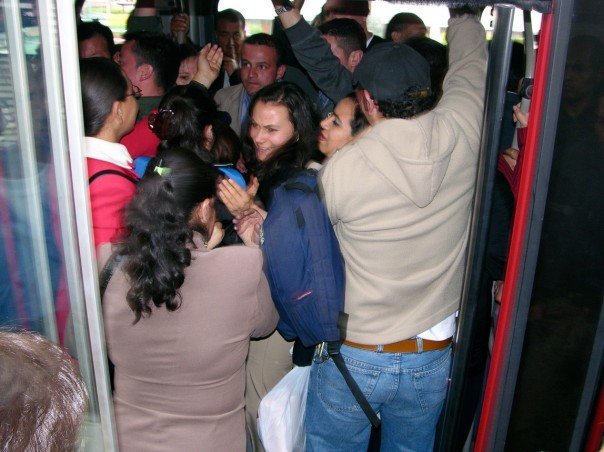
TransMilenio at rush hour.
In being forced to wait for, well, everything, many gringos can go crazy.

But I’ve found a way to compensate.

Crammed amongst a sea of sweaty people in a TransMilenio bus at rush hour, I search for my happy place like in Happy Gilmore. Entering a state of quasi-consciousness, I think simultaneously about everything and nothing. In this state, it does not bother me that a tiny 85-year old woman has her face awkwardly smashed against my stomach; that a fat, hairy man’s B.O.-sodden armpit is shoved in my nose; or that I know this will be my lot in life for the next 30-40 minutes.

Learning how to wait is one of the greatest gifts Colombia has given me.

But you should probably still make sure that my other gifts remain well-hidden.

Sunday, October 30, 2011

Election Day

Soldiers on patrol in Bogota.
Every day, when I walk down to catch the bus to school, I pass Museo Militar de Colombia, the country’s main military museum. Soldiers with automatic rifles stand guard at either end of the street leading up the museum to protect against those who might attack it. Colombia is, after all, still in the middle of a decades-long civil war and any military installation—even a museum—is a potential target.

Today, when I walked down to the tienda to buy some groceries, I encountered twice as many military guards and several police units on patrol. The increased security came as no surprise because today was Election Day in Colombia for local and regional offices.

It has been a rough couple of months for Colombian democracy—according to Colombia Reports, 41 political candidates were assassinated this year and many feared more attacks would occur today. To discourage alcohol-related violence, the government enacted ley seca (dry law), prohibiting the sale of alcohol Saturday evening through Monday. If nobody knew before that there were elections going on this weekend, they certainly found out when they learned they were unable to buy alcohol to celebrate Halloween last night.

Luckily, today’s elections came and went without any major attacks save for an attempted assassination in the Arauca department in northeast Colombia. This morning, the convoy of Representative Albeiro Vanegas Osorio, vice president of Colombia’s House of Representatives, came under attack by gunmen. Although Representative Osorio survived the attack, his driver was killed. Despite this and a few other acts of violence, the Colombian government said that there was an 86% drop in attacks compared to the last local elections in 2007.

Besides direct violence, corruption is probably the biggest threat to Colombian democracy; however, the Colombian government took steps to curb it. The government canceled 4 million identity cards (nearly 10% of eligible voters) suspected of being involved in electoral fraud. Even so, in at least one town in northern Colombia, there were more registered voters than actual residents.

Although Colombia is technically one of Latin America’s most long-lasting and stable democracies, the complicated nature of Colombian politics is enough to make even a Political Science major’s head spin. Regardless, Colombian democracy will live to fight another day and that’s more than many countries in this region can say.  

Thursday, October 27, 2011

La Costa Chronicles Part 3: Sweatin’ in Santa Marta

The Dreamer Hostel, Santa Marta.
We arrived in Santa Marta just before sunset after a five-hour bus ride down the coastal highway. Along the way, we had befriended some fellow American travelers, bonding over our mutual fear of premature death instilled by our happy-go-lucky driver’s penchant for dancing at the wheel.

Glad to still be counted among the living, Derek and I exited the bus and carried our bags inside the hostel. My first impression of The Dreamer Hostel was, “wow.” The hostel felt like a villa, with an open-air interior surrounded by nation-themed dormitories. We were assigned to Spain. There was an Italian restaurant, a bar, and even a swimming pool. Compared to the hostels I was used to, this was a major upgrade. And for all of this, it only cost about $11 USD a night.

After meeting up with my fellow WorldTeach volunteers, Pam and Katie, we sat down to eat at the Italian restaurant. As far as hostel food goes, it was actually pretty good.

Getting Iced by Pam.
I had spaghetti, in case you were wondering.

By the time we finished eating, a group of hostel-goers had gathered for trivia night and we joined them. Broken up into teams, we competed to answer questions about Colombia, Santa Marta, and general world history.

In the middle of the game, Pam came up to me with a bag of Goldfish crackers Derek had smuggled into the country and asked if I wanted some. Goldfish are my weakness, my brain food, and I had missed them dearly living in such a Goldfishless country.

Of course, I said yes.

Parque Tayrona entrance.
But when I reached into the bag to scoop up some of the little cheddar delights, my fingers found themselves touching a cold, hard bottle.

I looked up at her and said, “Seriously?”

She nodded and said, “Gotcha.”

Damn the Smirnoff gods… I had just been Iced again!

Confused but amused Europeans and Australians watched as I took a knee and polished off the Smirnoff Ice in one large chug.

The next day, Derek, Pam, and I hopped on a collectivo bus headed towards Parque Nacional Natural Tayrona, a national park near Santa Marta, where we planned to hike through the coastal jungle and spend the night on hammocks by the beach.

The bus dropped us off in a small village and we walked up a paved road to the park’s entrance. Although there was only a small group of people waiting to buy passes, it took us more than an hour to move to the front of the line—efficiency is not one of Colombia’s strong suits.

Derek and Pam hiking.
When we had finally registered our passports and gotten our passes, we waited around some more for a sketchy bus to drive us and some other hikers up to the staging area. The staging area turned out to be a surprisingly well-kept campground and we passed through it to head to the main hiking trail.

Although we had only just begun, I was already drenched in sweat—on Colombia’s Caribbean coast sweat is, like death and taxes, a fact of life. It is everywhere—covering your arms and legs, under your brow, and dripping down your back. There is little you can do to escape it—save for hiding out in air conditioned shopping malls.

Unfortunately, we were fresh out of shopping malls.

Sweat aside, it was a scenic and enjoyable hike. Along the way, I got to see some monkeys and way too many industrious leaf-cutting ants. We made our way through the dense jungle and soon ran into the coast, where we followed the trail along the beach. Walking on the beach next to the thick jungle made me feel like I had been teleported into an episode of LOST.

Cabo San Juan, Parque Tayrona.
Luckily, there were no smoke monsters in the vicinity.

After stopping to eat lunch on a large rock next to the ocean, we continued down the trail, passing through camping areas and locally-run tiendas selling everything from water to coconut rice. Finally, we arrived at our destination: Cabo San Juan.

Cabo San Juan is essentially a large, outdoor hostel. You pay to spend the night in either a hammock or tent and there is a restaurant that provides meals. You can also buy beer at their tienda. Although it was nearly dusk, Derek, Pam, and I were determined to drink a hard-earned beer and swim in the warm Caribbean waters.

Hiking in Parque Tayrona.
Beers in hand, we hung out in the water, befriending some Canadian and American backpackers who also happened to be staying at The Dreamer Hostel in Santa Marta. By random chance, one of the American girls heard me mention WorldTeach and she said she was friends with Adam—she had gone to college with him.

South America is indeed a small world.

When the sun finally set, the bugs came out in full force, and we retreated to shore.

That night, we ate dinner at the restaurant where everyone else had congregated. I had a traditional Colombian dish of chicken with rice and papas—not bad. We befriended a pair of American travelers and hung out with the other people from our hostel, playing some card games under the restaurant’s lights.

Our furry escort.
When it was finally time sleep, we headed to our hammocks, which were densely packed under a thatch-roof structure. Although some drunk guy had stolen my hammock, I managed to find a free one and claimed it as my own. This hammock-sleeping experience was much less relaxing than the one I’d had on Playa Blanca. For starters, Cabo San Juan was much more crowded and we were packed so tightly together that you were screwed if anyone near you was a snorer. Adding to the sleep impediments was a vociferous donkey that made annoying donkey noises all throughout the night. As if to add insult to injury, God decided to send a tropical storm our way, sending down torrents of pouring rain down against the thatch roof—making it like trying to sleep under Niagara Falls. Eventually, the snoring, the donkey, and the rain formed a twisted jungle lullaby and I drifted off to sleep.

By the next morning the rain had passed and we rolled out of our hammocks to catch some breakfast before taking off. Since Pam needed to be back in Santa Marta in time to catch a bus to Cartagena later that day, we headed out early.

With Derek in Parque Tayrona.
As we backtracked through the jungle, passing the homes of the locals that worked in the park, a small dog decided to tag along, following us as we walked along the beach. Every time we stopped to drink some water, the dog waited and looked back at us. After we had gone a few miles, I began to worry that the dog would not be able to make it back home, but once we left the beach for the interior, our furry escort decided he had gone far enough and peaced out.

We had been walking for a while when I realized that we were not on the same path that we had gone in on. I normally have an above-average sense of direction and knew we must have taken a wrong turn somewhere. We were passing over a muddy mess of a road covered with horse crap and mud holes. The path was also slippery and if you fell, you would literally be eating… well you know.

After a few hours of hiking, we were relieved to see that we had made it to the staging area. We took another sketchy bus down the hill and returned to the hostel in Santa Marta.

With my nemesis, Pam.
That night, Derek and I headed to the nearby town of Taganga to meet up with my friends Alyssa (my Baruvian Icer) and Nina. I had heard many things about Taganga, the foremost being that it was a fun party town. When we arrived in the small seaside pueblo, I thought someone must have been mistaken—the place was run down and full of trash, much like southern Bogotá.

We headed to “downtown” Taganga, where there was a concert going on in a park by the beach. Amidst the Colombian crowd, we hung out and listened to salsa and reggaeton and watched the locals pull some crazy dance moves.

Later, we headed to a bar on the cliff side that was supposed to be fun. When we entered the bar, the first thought that entered my mind was, Welcome to Gringolandia. The place was filled to the brim with gringos of every shape and size; roughneck Australians, overly dressed Englishmen, and wasted Americans.

In Parque Tayrona.
I bought a beer and turned to join my friends on the dance floor, when a shady Colombian approached me to offer what he claimed was a good deal for coke. I ignored him and continued on to my friends. Despite being an overly gringo affair, it was a fun night and we had a good time dancing on the open-air terrace overlooking the Caribbean.

The next day, I lounged in a hammock back at the hostel, surprisingly not hungover and enjoying the sun’s warmth. I tried not to think about the fact that the next day I would be returning to stormy, freezing Bogotá and appreciated the day as best I could.

Soon, it would be back to the grind.